Shooting panoramas for PTgui template collection
|
|
|
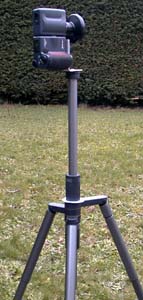
The tripod I used : a Cullmann Magic 2. I choosed it mainly because if the column is not locked, it can be freely rotated, thus avoiding the need of a panoramic head. The top of the column is small and minimizes touching up of spherical panoramas to suppress the tripod. |
|
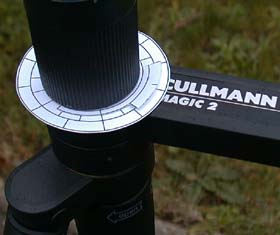
A cardboard protractor with two scales, one every 20°, the other every 30° is taped to the tripod, an index is taped to the rotating column. The plate with the logo is a nice place to put a bubble level to verify that the camera is rotating in an horizontal plane. |
|
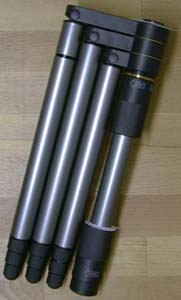
This tripod is not the stiffest you can get, but it is lightweight and very compact when folded. And you can get rid of a bulky and heavy panoramic head while keeping good precision in your shooting. (for an even lighter solution, see my virtual tripod method !). It can also be used as a monopod, see for example John Wood's monopod setup for panorama shooting. |
|
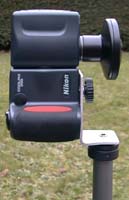
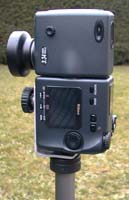
My trusty L-bracket was used for all fisheye (Nikon FC-E8) shots. |
|
The same L-bracket was also used for all portrait-mode (vertical) photos (with or without Nikon WC-E24 wide angle adaptor). But this time the Coolpix is fixed on the other side of the bracket to rotate near nodal point. (There is -among other tips- a list of Coolpix nodal point positions at Dave and Pat's www.360texas.com) |
|
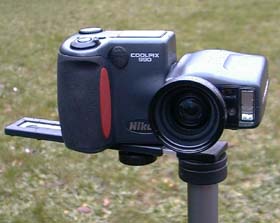
A flash bracket was used to position the optical axis of the camera over the rotating point for all landscape-mode (horizontal) photos. |
|
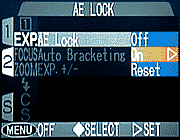
Automatic exposure is locked to avoid differences of color or luminosity between adjacent images... Remaining discrepancies between images is generally caused by lens flare : try to avoid direct sunlight on the lens, especially with the fisheye. |
|
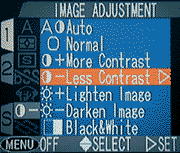
...and the "less contrast" mode is used to try to maintain details in both high lights and shadows. |
|
|